
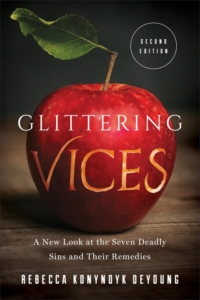
GLITTERING VICES | SMALL GROUP STUDY MATERIAL
Written by Ben Wimmers, Pastor of Youth and Family
for Fleetwood CRC, Langley Immanuel CRC, and Living Hope CRC
Introduction
Welcome to the Glittering Vices Small Group Study Guide! It has been a joy and a challenge to read through Glittering Vices by Rebecca Konyndyk DeYoung; it is my hope that you find our Lenten sermon series and the subsequent discussions will leave you feeling likewise. It is my privilege to be a fourth voice in this series, being able to speak with you and your small group as you wrestle with the sermons of Pastors Chris, Justin, and Steve. It is my hope that you find the substance of their preaching transformative and that this guide serves to draw you deeper into the truths they unfold each Sunday morning.
You will note that I’ve included Lust as an additional session. Since lent only has 6 Sundays we will not be covering lust, but the option is there for each group to treat each separately or at once based on the ideas from the sermon.
This guide will assume that you have listened to the corresponding sermon, but that you have not read DeYoung’s book. There will be quotes from the book throughout this guide, providing an opportunity to deepen your discussions. Page numbers from Glittering Vices accompany the quotes if you have a copy and want to dig into the broader context of DeYoung’s work.
Glittering Vices
Within this study, we will explore the Seven Deadly Sins, or Vices. Within the Christian tradition, these seven have emerged as capital vices, from the Latin capitis, which means head or source. We explore these seven, not because they are the only sins or vices that we can experience, but because all our sins can be understood as flowing out of one or more of these vices.
A vice (or its counterpart, a virtue), first of all, is a habit or a character trait. Unlike something we are born with—such as an outgoing personality or a predisposition to have high cholesterol levels—virtues and vices count as moral qualities. We can cultivate habits or break them down over time through our repeated actions (7).
This study will be an exploration of our hearts and habits, as both inform and shape each other. The invitation will be to investigate how our hearts and habits have been misshappen by the vices and how the gospel, by the work of the Holy Spirit reforms us.
Before you begin:
Write down a definition of each of the vices, as you understand them, or write down what you believe to be the most common definition that Christians would likely define it as. We will compare them to Rebecca DeYoung’s definitions as we go. I hope that it we be a good exercise to begin each session, wrestling with our preconceived notions of the vices and how they might be affirmed or turned on their heads.
Here are a few questions that can be used as a starting point for each session.
- What stood out to you from the pastor’s sermon?
- What was new or surprising?
- What would you like to learn about more?
- How were you challenged?
Pride/Vainglory
Vainglory is the excessive and disordered desire for recognition and approval from others (42).
Pride excessively concerns excellence itself (i.e., my excelling others); vainglory, by contrast, concerns primarily the display or manifestation of my excellence (45). In other words, it doesn’t even matter so much if you are good at something, what matters more is if you are seen as good at it.
- How do these definitions of Pride/Vainglory compare with yours? What is the same or different?
- Where have you seen vainglory prized in culture? Can you think of examples in your own life?
“Be careful not to practice your righteousness in front of others to be seen by them. If you do, you will have no reward from your Father in heaven. “So when you give to the needy, do not announce it with trumpets, as the hypocrites do in the synagogues and on the streets, to be honored by others. Truly I tell you, they have received their reward in full. But when you give to the needy, do not let your left hand know what your right hand is doing, so that your giving may be in secret. Then your Father, who sees what is done in secret, will reward you.” (Matthew 6:1-4)
- Why do we love recognition for the things we do well?
- Why is the temptation to flaunt our righteousness so serious, and so easy to succumb to?
“You are the light of the world. A town built on a hill cannot be hidden. Neither do people light a lamp and put it under a bowl. Instead they put it on its stand, and it gives light to everyone in the house. In the same way, let your light shine before others, that they may see your good deeds and glorify your Father in heaven.” (Matthew 5:14-16)
- How do we determine if we are shining a light that points to our glory or to God’s glory?
“This is to my Father’s glory, that you bear much fruit, showing yourselves to be my disciples.” (John 15:8)
Relinquishing our reputation-seeking yields a significant reward: we have a chance to be truly known and loved (59).
- What holds us back from letting people know the real us, instead of the reputation that we have cultivated?
- Before we can be known by others, we must first allow ourselves to be known by God (and to know him). What practices help you to be known by God?
Remedy to Pride/Vainglory:
Jesus modeled a spiritually healthy rhythm of sociability and solitude: he ministered among the crowds, teaching and healing, but balanced that work by withdrawing often to a solitary place to pray (61-62).
- How does solitude work against pride and vainglory?
- What does solitude look like for you?
Envy
DeYoung describes envy this way: In envy, we eye the internal qualities of another person, qualities that give a person worth, honor, standing, or status (69). Envy can also be described as not being able to delight in the good that someone else is experiencing because you want it for yourself.
- How does DeYoung’s definition of envy compare to your own?
- Consider the difference between envy and jealousy. “Jealousy counts as envy’s close cousin because both are personal and related to love. The jealous “have” something or someone they love but might lose. The envious, by contrast, are “have-nots”—they do not have the good their rival does, and they do not have self-love either. Thus, they have nothing to lose and everything to gain from another’s loss” (70). How do you see the difference between envy and jealousy?
DeYoung notes that envy is a matter of self-worth. The envious care how they stack up against others because they measure their self-worth comparatively (71).
- Comparison is a thief of joy; a common phrase that points to envy as the root of this joyless comparison. Why does envy love comparing and why is the result joylessness?
- What internal qualities (that give honor, standing, and status) are people most envious of, most likely to compare themselves to?
In short, the envious resent God, feel bitter toward others, and condemn themselves to a hell of their own making already on earth (79).
- Why might the envious resent God and others?
- Why does DeYoung say that the bitterness and resentment they feel originates from the envious person themselves?
The Remedy to Envy:
Overcoming envy requires acknowledging a deeply human need for unconditional love. It likewise requires that we acknowledge the divine source of such love (82). The cure for envy is not contentment, it is not being ambivalent about what others have, but loves others and desires to see them flourish.
Isaiah 43:1-4 “But now, this is what the Lord says— he who created you, Jacob, he who formed you, Israel: “Do not fear, for I have redeemed you; I have summoned you by name; you are mine. When you pass through the waters, I will be with you; and when you pass through the rivers, they will not sweep over you. When you walk through the fire, you will not be burned; the flames will not set you ablaze. For I am the Lord your God, the Holy One of Israel, your Savior; I give Egypt for your ransom, Cush and Seba in your stead. Since you are precious and honored in my sight, and because I love you, I will give people in exchange for you, nations in exchange for your life.”
- How do we come to know that God loves us unconditionally, that our value comes from his love, rather than the things in life we are most envious of (and value most)?
- Isaiah speaks about God’s fierce love for his people, his unconditional love, as evidenced by the way he has saved them. What stories from your life affirm that God loves you unconditionally?
Quiet benevolence also develops a habit of acting for others’ sake in ways that are not instrumental to engineering superiority or status for ourselves (83).
- What quiet acts can you do this week, that do not build your reputation, but show God’s unconditional love?
Acedia
Acedia often shows up as apathy, a comfortable indifference to duty and neglect of others’ needs (89). Acedia comes from a Greek word that means ‘the lack of care’ and can also be seen as a failure to love God and others with our whole self.
- How does this definition of sloth compare with your own?
“Not only can acedia and ordinary diligence exist very well together; it is even true that the senselessly exaggerated workaholism of our age is directly traceable to acedia.” It turns out that both the apathetic inertia of the lazy person and the perpetual motion of the busy person can stem from a heart afflicted by this vice, according to the traditional conception.(90)
- When looking at DeYoung’s definition of acedia, how does simply working harder and being busier fail to be the remedy to the sin of acedia?
- What reasons are typically given to the ‘lazy person’ to encourage them to cease in their laziness and work harder?
- The earliest descriptions of acedia call it the noonday demon because it was at the heat of the day that early monks felt distracted from their calling and duty in prayer. They would comment that acedia comes with a listlessness, a discontent with where they were and what they were doing. How has this aspect of acedia impacted our culture? Have you seen this part of acedia in your life?
Thomas Aquinas, one of the great thinkers in Christian history who wrote a lot about vices and virtues in the 1200s, begins with the cryptic definition of acedia as “aversion to the divine good in us.” (94)
- What do you think this means?
“The divine good in us,” in Aquinas’s medieval-ish way of talking, means the indwelling of the Holy Spirit in our hearts—God’s life in us. Paul puts it this way: “I have been crucified with Christ; and it is no longer I who live, but it is Christ who lives in me” (Gal. 2:19–20). (95)
- Why might we resist the work of the Holy Spirit in us (either by doing nothing or by busying ourselves with our own tasks)?
- Why do we prefer to do our own things (or nothing at all)?
The Remedy to Acedia:
Acedia’s resistance targets nothing less than the gift of the Holy Spirit and our new identity in Christ.(96)
- Before turning to scripture, work as a group to list the characteristics define the Christian life?
- Look at 2 Peter, to see what characteristics mark the Christian life.
2 Peter 1:3-7 “His divine power has given us everything we need for a godly life through our knowledge of him who called us by his own glory and goodness. Through these he has given us his very great and precious promises, so that through them you may participate in the divine nature, having escaped the corruption in the world caused by evil desires. For this very reason, make every effort to add to your faith goodness; and to goodness, knowledge; and to knowledge, self-control; and to self-control, perseverance; and to perseverance, godliness; and to godliness, mutual affection; and to mutual affection, love.”
Note: Peter calls his readers to make every effort in the cultivation of the life transformed by the work of the Spirit. Acedia is not opposed to effort, but rather opposed to putting effort into the right things, as DeYoung says, “Whether through laziness or busyness, when we have acedia, we avoid changing, stretching, or giving ourselves”.(100-101)
- Looking at Peter’s list of characteristics of the Christian life – which ones challenge acedia?
- What practices and rhythms help you nurture a healthy spiritual life? What might you need to change to resist acedia (either as laziness or busyness)?
- DeYoung suggests Sabbath as a healing practice for those with acedia. How might our resting well actually lead to healing us from our distracted and disordered loves?
Avarice (Greed)
Aquinas’s definition bears this out: we are greedy when we excessively love or desire money or any possession money can buy (113). “[Note] how our greedy tendency to trust in wealth for happiness and security undercuts our trust in God. Like the other vices rooted in pride, greed expresses the do-it-yourself method of finding happiness, instead of the contentedness of receiving the good things that God gives us and gratefully depending on his provision”(114).
- How does this definition compare with yours?
- What drives our culture’s obsession with wealth and the things it can buy?
Luke 21:1-4 “As Jesus looked up, he saw the rich putting their gifts into the temple treasury. He also saw a poor widow put in two very small copper coins. “Truly I tell you,” he said, “this poor widow has put in more than all the others. All these people gave their gifts out of their wealth; but she out of her poverty put in all she had to live on.””
- Why does Jesus point to this poor widow as the picture of generosity? How is greed absent from her giving when compared to the rich (who are still giving to the temple)?
- Ambrose says one of the most influential preachers of the early church wrote, ‘it is the heart that makes the gift rich or poor, and gives things their value. ‘It is the heart that makes the gift rich or poor, and gives things their value.’”(116) What do you make of Ambrose’s words? What postures of the heart are present if gifts given well? What about the heart that gives improperly?
Consider the following scripture passages and a quote from DeYoung:
1 Timothy 6:10 “For the love of money is a root of all kinds of evil. Some people, eager for money, have wandered from the faith and pierced themselves with many griefs.”
Hebrews 13:5-6 “Keep your lives free from the love of money and be content with what you have, because God has said, “Never will I leave you; never will I forsake you.” So we say with confidence, “The Lord is my helper; I will not be afraid. What can mere mortals do to me?””
When we let avarice take root, we don’t merely want to have more; each of us wants things to count as mine. But in the end, do we possess our possessions, or are we possessed by them?(117-118)
- What drives us to desire ownership of things, to be able to declare that something is mine? How does the desire for ownership feed our love of money?
The Remedy to Avarice:
In opposition to avarice/greed, stands generosity. “The generous are looking for opportunities to give because they recognize what they have themselves received as a gift.” (123)
- Why is generosity the remedy to greed? Explore how it impacts your heart and where you place your trust (God or money).
- What makes generosity difficult? When is it easy?
- What regular practices can grow generosity in your heart?
Wrath
Is anger good or bad? The Christian tradition is divided over making an absolute claim over the nature of anger. Let’s begin with a few questions to help us understand our own understanding of wrath.
- What do you get angry about most often?
- How do you express that anger?
For many of us, anger is a problem, one that often reveals a spiritual problem. As the opening story illustrates, we express this emotion when something interferes with what we expect or feel we deserve.(138) Anger rightly expresses the thought, “This is not the way it’s supposed to be! Something ought to be done to set things straight!”(140) Anger turns wrathful when it fights for its own selfish cause, not for justice, and when it fights dirty.(144) Wrath’s fighting power tends to protect my ego and entitlements, to the exclusion of the claims of others.(145)
- How does DeYoung’s explanation of the root cause of anger reframe how we think about it?
- What does our culture say we should be most angry about? What does it say we deserve the most in life, that we should be angry when we do not receive it?
What about God? What can you say about God’s anger?
- What angers God? He is angered when his people break the commandments (being unfaithful to God and each other; Matthew 22:37-39, Mark 12:29-31)
- How is God angry? God is slow to anger and abounding in love.
- How does God’s anger inform us about what we should be angry about?
Look at the way Jesus is moved to anger:
John 2:17 “His disciples remembered that it is written: “Zeal for your house will consume me.””
Mark 3:4-5 “Then Jesus asked them, “Which is lawful on the Sabbath: to do good or to do evil, to save life or to kill?” But they remained silent. He looked around at them in anger and, deeply distressed at their stubborn hearts, said to the man, “Stretch out your hand.” He stretched it out, and his hand was completely restored.”
- What is the difference between wrath and zeal?
- What was Jesus angry about and how did he express that anger?
The Remedy to Wrath:
Anger, when it is a holy emotion, has justice as its object and love as its root (156).
Luke 6:45 “A good man brings good things out of the good stored up in his heart, and an evil man brings evil things out of the evil stored up in his heart. For the mouth speaks what the heart is full of.”
- How do we cultivate our hearts to love God’s justice and act out of love towards injustice?
- How can our anger be directed more to the injustices others receive, rather than just acting our when we feel a perceived injustice?
Gluttony
Put simply, this vice gluts on pleasure, reducing human life to self-gratification (165).
- How does this definition compare with yours?
Consider the acronym FRESH: eating fastidiously, ravenously, excessively, sumptuously, and hastily (166).
Fastidiously – focused on our specific desires (“All I want is…”), demanding that they be met so that they can have a pleasurable experience.
Ravenously – taking much of a pleasurable thing.
Excessively – consume beyond full, for the sake of taste (pleasure)
Sumptuously – focused on the desire to eat and be filled with our most pleasurable foods (and only those foods).
Hastily – moving quickly to ensure you get what you find pleasurable, out of fear of there being not enough.
- What stands out to you from these 5 aspects of gluttony? Which seem most common, which was the most surprising?
Eccl 6:7 “Everyone’s toil is for their mouth, yet their appetite is never satisfied.”
The author of Ecclesiastes points to the way in which eating in a FRESH way leads to dissatisfaction, and that one must continue to work harder to satiate their appetite for pleasurable foods.
- What is the purpose of food? Share the time you experienced a memorable meal; what made it memorable?
FUN FACT: To have too little desire—the vice of insensitivity—and shun good things therefore counts as a disordered attitude along with having too much desire—the vice of gluttony (175).
The Remedy to Gluttony:
1 Tim 6:6 “But godliness with contentment is great gain.”
- What practice can help us retrain our appetites towards seeking contentment instead of only pleasure (food can still be enjoyable!)?
Greater abstinence from food may help us focus on spiritual goods and focus our prayers in a way that discipleship in general or a particular kingdom task requires.(179)
Matthew 4:1-2 “Then Jesus was led by the Spirit into the wilderness to be tempted by the devil. After fasting forty days and forty nights, he was hungry.”
- As Jesus prepared for ministry, he fasted. What is your experience with fasting? How can it help us be free from the vice of gluttony? How can it help draw us closer to God?
Lust
The chapter on Lust is available on request from the office. It is recommended that you read this chapter in advance of the discussion to enrich your conversation.
Lust says, Sexual pleasure is my pleasure (196).
- How does this description compare to yours?
In lust, I decide to make my own pleasure the goal, and then I decide where to get it, and when, and how (200).
- What is the harm, to either oneself or another, by making sexual pleasure about satisfying one’s own needs?
God created us as sexual beings; we bear God’s image in our maleness and femaleness, as the poetic parallelism of Genesis 1:27 indicates. God designed human beings with sexual bodies capable of attraction and arousal. Our sexuality—including bodies, hormones, and the tactile desires and pleasures that go with them—counts as a good gift from God. (191)
- How does lust corrupt this truth, that sexuality is a gift from God?
The Remedy for Lust:
1 Cor 6:18 “Flee from sexual immorality. All other sins a person commits are outside the body, but whoever sins sexually, sins against their own body.”
- What does it look like to flee sexual immorality in our culture? How do we flee it in a way that still affirms the God-given goodness of sexuality?
Lust thrives in privacy and isolation. Lustful people often feel shame, which also motivates them to keep their struggles hidden from others. But when we hide our hearts, we cannot come to grips with the darkness within, or expose it to the light in confession. This means lust’s remedy requires community, openness, and accountability. Sheer individual willpower will not work. You will not beat this vice alone. Lust’s vicious cycle copycats the dynamics of addiction (212).
- How can community be a factor in addressing lust? What is the posture of such a community towards those struggling with lust?
Phil 4:8 “Finally, brothers and sisters, whatever is true, whatever is noble, whatever is right, whatever is pure, whatever is lovely, whatever is admirable—if anything is excellent or praiseworthy—think about such things.”
- What does it look like to speak about sexuality in a way that demonstrates its “excellence and praiseworthiness”?
- What is the place for chastity in our conversation on lust?
DeYoung Notes that in the case of the desire for sexual pleasure, being called to love your neighbor as yourself means that respecting persons and their bodies includes both your neighbor’s body and your own.(208)
John 15:12 “My command is this: Love each other as I have loved you.”
- How do we love ourselves and our neighbours in a way that honours the image of God in each of us?